
New Haven County Court Records After a Jail Arrest
Connecticut works differently from most states. There is no county sheriff jail, no county court clerk, and no county district attorney. In 1968 the state folded the old county jails into one Department of Correction. So after a New Haven County arrest, the custody side and the court side run on two separate statewide systems. The court side is what creates the records most people search for.
The path is short to describe. Police make the arrest. The person is booked and, if held, passes into Department of Correction custody. A prosecutor reviews the file and decides what to charge. Once charges are filed, a criminal case opens and the court record begins. From that point on, the case, its docket, and its charges are tracked by the Connecticut Judicial Branch. The custody map is statewide: the Department of Correction runs the jail-like correctional centers, the Judicial Branch publishes the court docket, and the Division of Criminal Justice prosecutes the charges.
Keep two record types apart. The custody record shows where a person is held right now. To check current custody and booking detail, use the jail inmate records page. Booking photos are a separate question covered on the jail roster mugshots page. The court record is the third piece. It is the formal charge sheet, the docket number, the court dates, and the outcome. A booking entry is not the court record, and a court record is not proof of where someone sits today.
The State's Attorney and How Charges Get Filed
The prosecutor in New Haven County is not called a district attorney. The job belongs to the Office of the State's Attorney for the Judicial District of New Haven, part of the statewide Division of Criminal Justice. The current New Haven State's Attorney is John P. Doyle, Jr. He was appointed by the Criminal Justice Commission on June 20, 2022. He is the chief law enforcement officer for the district and supervises its prosecution offices.
The New Haven Judicial District serves Branford, Bethany, Cheshire, East Haven, Guilford, Hamden, Madison, Meriden, New Haven, North Branford, North Haven, Wallingford, and Woodbridge. Charges are split between two kinds of offices by how serious the case is. The Part A office at New Haven Superior Court takes the most serious matters, mostly class A and B felonies, from across the whole district. The Geographical Area offices, called GA offices, handle the rest. A felony is a serious crime; a misdemeanor is a lesser one; an infraction is lower still.
The official New Haven Judicial District State's Attorney page explains who files charges and where they sit. 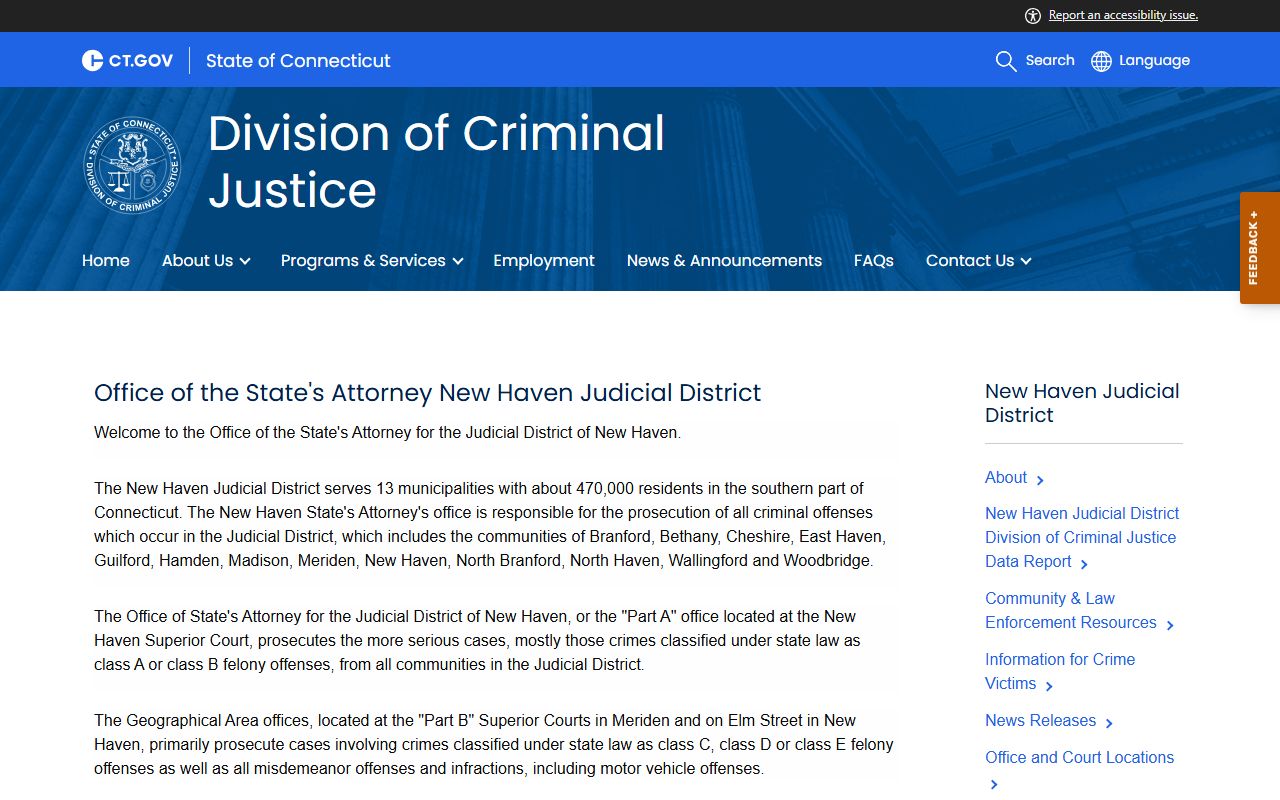 That page lists the office address, the towns served, and the prosecutor in charge. The table below shows the split between the two office types.
| Part A Office | Geographical Area Office | |
|---|---|---|
| Which Charges | Most serious cases, mostly class A and B felonies | Class C, D, and E felonies, misdemeanors, infractions, motor vehicle offenses |
| Where | New Haven Superior Court | Meriden and Elm Street in New Haven |
| Scope | All towns in the district | The local court area |
Note: The prosecutor can amend, reduce, drop, or proceed on different charges than the ones first listed at arrest, so the court record is the better source.
Pending Case Search by Defendant
The main public tool for New Haven County court records after an arrest is the Connecticut Judicial Branch criminal and motor vehicle lookup. It offers several searches. The first one most people need is the pending case search by defendant name. It finds open criminal and motor vehicle cases. The last name is the only required field, and it works as a begins-with prefix. The other fields just narrow the result.
You can preview the form on the official pending case search by defendant page. 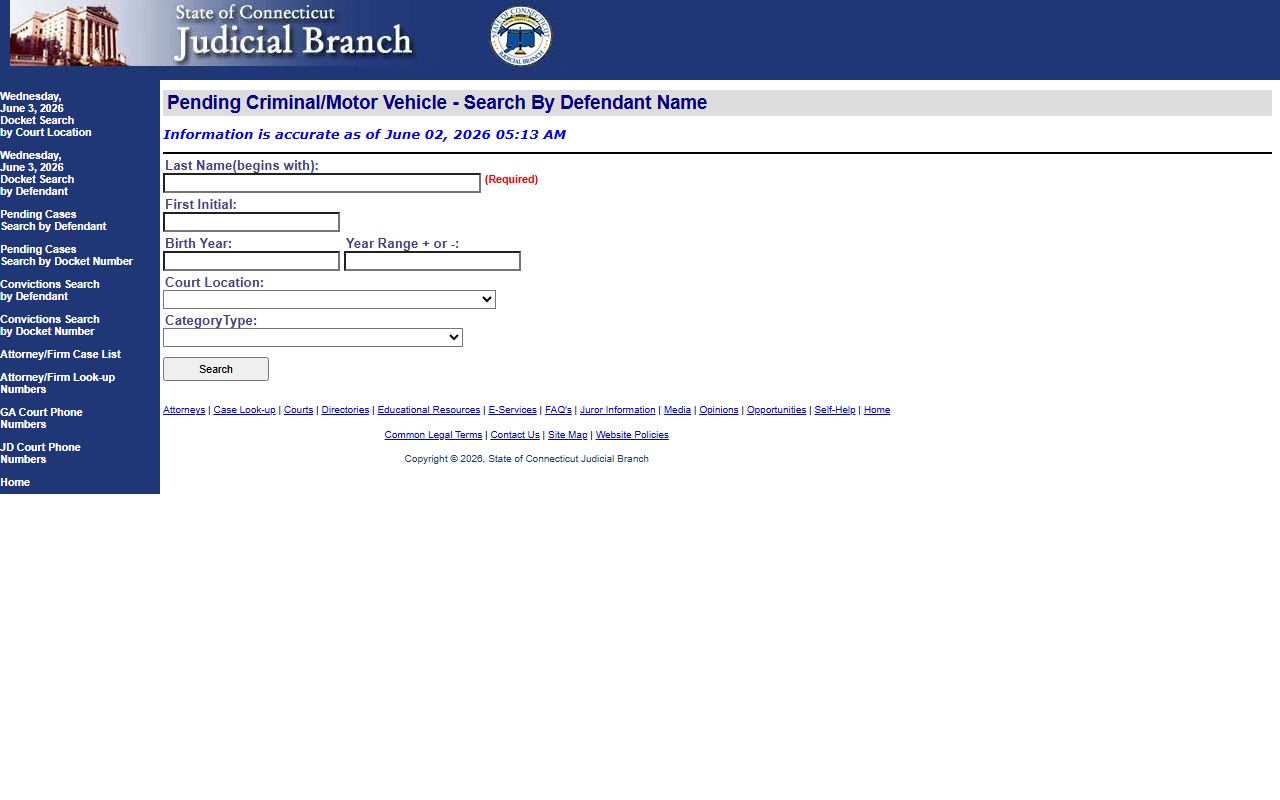 The form shows each field and the court location dropdown. The table below lists what each field does.
| Field | Required | Notes |
|---|---|---|
| Last Name (begins with) | Yes | Prefix search, up to 60 characters. |
| First Initial | No | One character to narrow common names. |
| Birth Year | No | Four digits to cut false matches. |
| Year Range + or - | No | One character; widens the birth-year band. |
| Court Location | No | Statewide GA and JD dropdown, including New Haven GA 06, GA 08, GA 23, and New Haven JD. |
| CategoryType | No | Criminal; Motor Vehicle; Referred for MV/Boat License/Reg Suspension. |
Running it takes only a few steps.
- Open the Judicial Branch pending case search by defendant.
- Type the last name. Add a first initial and birth year to reduce false matches.
- Pick a likely court location if you know one, or leave it blank to search all locations.
- Choose a CategoryType, then select Search and read the case list that returns.
Pending Case Search by Docket Number
When you already have the case number, the docket number search is faster and cleaner than a name search. A docket number is the court case number for a single matter. Name searches can be broad and pull back many people. A docket number points to one case. The Connecticut docket number search form breaks the number into parts so the system can route the lookup.
You can see how the number is split on that form. 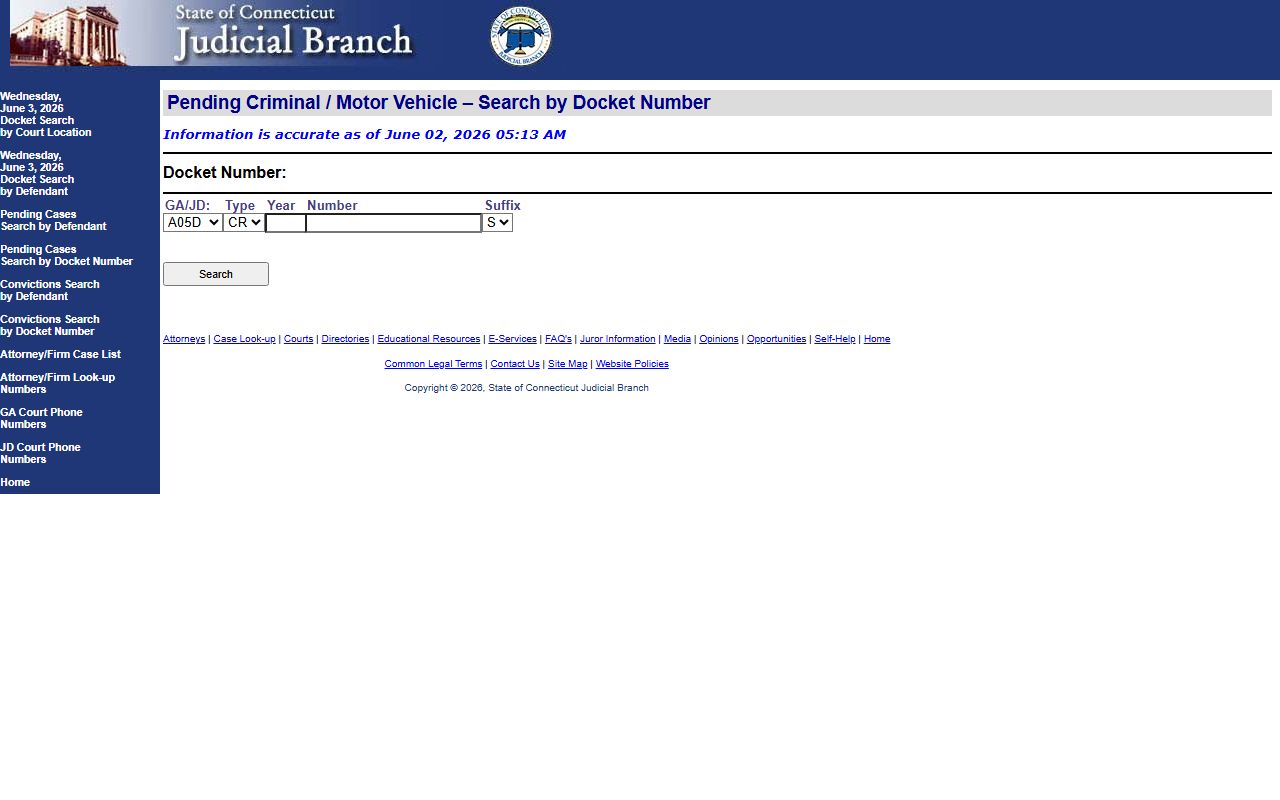 The form asks for a court code, a case type, a two-digit year, a number, and a suffix. Each part has a meaning. The GA or JD code is the court location. The type is the case category. The year is when the case opened. The number is the file number, and the suffix is a trailing code.
For New Haven cases, the court code values include N06N, N07M, N08W, N23N, and NNH. The type values are CR for criminal, MV for motor vehicle, CI, and MI. The year field takes two digits. The number runs up to seven digits. The suffix is a dropdown with values such as S, T, A, and 0 through 9. If you have all the parts, enter them and select Search. If you do not have the full number, fall back to the defendant-name search instead.
Conviction Search and Display Limits
The Judicial Branch also offers a conviction search by defendant. It uses the same name fields as the pending search. The difference is what it shows. Pending search finds open cases. Conviction search finds completed convictions, but only within strict display limits. Those limits are why a real case can be missing from the result.
The conviction menu and the wider lookup options sit on the main criminal and motor vehicle case lookup menu. 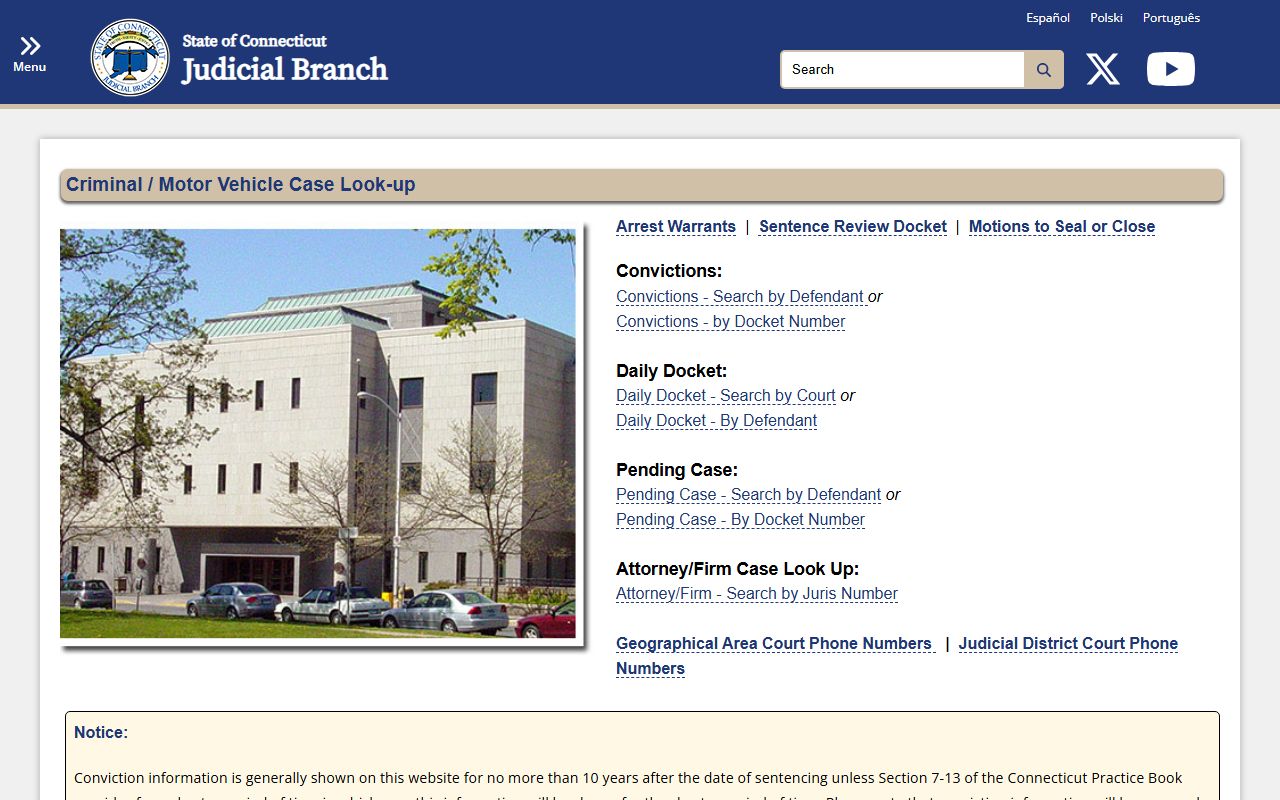 That menu links pending, conviction, daily docket, docket number, and arrest warrant searches. The display rules apply mostly to the conviction search.
Conviction information is generally shown for no more than 10 years after sentencing. A shorter period can apply under Practice Book section 7-13. The record is removed one month before the relevant period ends. Several categories never show at all. Youthful Offender cases, juvenile cases, infractions, and violation convictions are not displayed. Convictions from unvacated bail or collateral forfeitures show in motor vehicle cases but not in non-motor-vehicle cases. The Judicial Branch is plain that this lookup is a public display service, not the official court record. For a certified copy, you go to the clerk of the court of record.
Note: A missing conviction result does not mean no arrest happened, since the case may be pending, erased, excluded, or simply outside the 10-year window.
New Haven Court Locations to Pick
The court location dropdown trips people up. It is not a county filter. It exposes statewide Geographical Area, Judicial District, Housing, and Community Court entries. New Haven County does not map to one entry. So the dropdown is a narrowing tool, not a required county selector. Leaving it blank searches all locations, which is often the safest first move.
If you do want to narrow, the New Haven choices and the nearby county options matter most. A New Haven County arrest can land in different court paths depending on the town, the arresting agency, and the charge class.
- New Haven Geographical Area 06, 08, and 23 for many New Haven criminal and motor vehicle matters.
- New Haven Housing and New Haven Judicial District for housing sessions and the most serious district cases.
- Meriden Geographical Area 7 for Meriden-area matters in the district.
- Milford Geographical Area 22 and Milford Judicial District for towns served by the Ansonia and Milford area.
- Derby Geographical Area 5 and Waterbury Geographical Area 4 or Waterbury Judicial District for county towns routed that way.
The lesson is simple. Do not assume every New Haven County case sits in a New Haven entry. When in doubt, search with the location blank, then read the case to see which court it actually belongs to.
Charges vs. Convictions in Court Records
Being arrested and charged is not the same as being convicted. A charge is an accusation. It rests on probable cause, a low legal bar that means there is reason to believe a crime occurred. A conviction comes only after a guilty plea or a verdict, and that takes proof beyond a reasonable doubt. Both can appear in court records while they are within the display rules, but they mean very different things.
| Charge | Conviction | |
|---|---|---|
| Stage | Accusation filed by the prosecutor | Guilty plea or verdict |
| Proof Needed | Probable cause | Beyond a reasonable doubt |
| Public Record | Yes, while pending and displayed | Yes, within the display window |
Charge status changes as a case moves. A pending charge is still open and not yet resolved. A nolle, short for nolle prosequi, is the prosecutor's decision not to proceed for now; in Connecticut a nolled charge becomes subject to erasure after a set time passes. A dismissed charge has been thrown out by the court. A not-guilty finding means the person was tried and acquitted. The charges first booked at arrest can differ from what the prosecutor finally files, which is one more reason the court record beats the booking sheet.
Bond and Release After a New Haven County Arrest
Bond is a court matter, not a sheriff matter. After an arrest, the arresting agency and the court decide whether a person is released, given a promise to appear, or held for court and state custody. If a case is open, the pending case search shows the court and case context. Formal release terms, though, come from the court or counsel, not from a roster. The Department of Correction facility pages do not publish a bond desk, posting hours, or accepted payment methods.
Bond comes in a few common forms. The terms below cover what you may see after a New Haven County arrest.
- Cash Bond
- Money posted to meet a court release condition. The exact posting office and payment method are not published on the state facility pages, so confirm them with the court.
- Surety Bond
- A bond backed by a licensed surety or bondsman where allowed. No private bondsman is listed or endorsed here.
- Promise to Appear or Recognizance
- Release based on a written promise to return to court rather than a full cash payment, when the court or procedure allows it.
- No-Bond Hold
- A hold where money alone will not produce release. Verify the reason with the court or facility.
- Detainer or Hold
- A notice from another agency, such as immigration or another jurisdiction, that can block release even when the local case looks bailable.
The honest gap here is real. The official facility pages reviewed did not publish a bond fee table, a bond desk schedule, or payment rules. So posting instructions and exact bond conditions must be confirmed directly with the court or the facility before you act.
Warrants That Lead to an Arrest
Many arrests start with a warrant. The Connecticut Judicial Branch links an arrest warrant search from its criminal and motor vehicle lookup menu. Treat that as the official state warrant channel. There is no New Haven County sheriff warrant list, because the county does not run that structure. A warrant-related arrest can produce three separate trails: the warrant or court route, the custody route once the person is detained, and the pending case or docket route after court processing.
Warrant types are worth knowing. An arrest warrant is a court order to take a person into custody. A bench warrant or failure-to-appear warrant issues when a defendant misses court or breaks a court rule. A violation of probation warrant, often shortened to VOP, issues when someone breaks the terms of probation. A search warrant authorizes a search and does not by itself mean custody.
One special line exists for a narrow case. The Department of Correction runs a Fugitive Tip Line at (860) 982-2372 for parole absconders and transitional supervision escapees. That line is not a public warrant lookup for ordinary arrests. For a county arrest with no immigration twist, the court warrant search and the pending case search are the right tools.
Erasure and Why Old Cases Disappear
Connecticut does not use the words sealed and expunged the way many states do. It uses erasure. Under Conn. Gen. Stat. section 54-142a, qualifying records are erased, which can include police, court, and state's attorney records. Erasure applies to cases that were dismissed, nolled, ended in a not-guilty finding, resolved by a pardon, or based on an offense that was later decriminalized. The result is that some records vanish from public display rather than stay visible forever.
There is a second statute that matters for data resellers. Conn. Gen. Stat. section 54-142e requires anyone who buys or mass-requests criminal matters of public record from the Judicial Department or criminal justice agencies to update and delete erased records once they receive erasure information. So an old copy on a commercial site is not proof a record still stands. The contrast between an erased record and one still on display is sharp. An erased record is pulled from public lookup, usually after a dismissal, nolle, not-guilty finding, pardon, or decriminalized offense, and data resellers must delete it once they get the erasure notice. A record still on display is one that stays visible because it is a pending case or an in-window conviction that the law still allows to show.
The practical takeaway runs both ways. A missing result does not prove an arrest never happened. The case may be pending, erased, excluded by category, or outside the 10-year display window. The Judicial Branch warns that its data changes daily as erasures, pardons, corrections, and other modifications are entered.
Connecticut access statutes. Public access and erasure run on a handful of laws: section 1-210 on public records, section 1-215 on the record of arrest, and sections 54-142a and 54-142e on erasure and the duty to delete erased records.
Restricted Court Records in New Haven County
Not every court record after an arrest is open to the public. Several categories are restricted by law or kept off the public lookup. Juvenile cases are not displayed in the criminal lookup. Records held under the Youthful Offender Statute are excluded too, which is why some young defendants do not appear in a public search even when a case exists. Under Conn. Gen. Stat. section 1-215, parts of an arrest record can be sealed, and the statute defines what counts as the record of arrest and which portions stay protected.
A few unusual paths sit outside the ordinary flow. Some defendants found not guilty by reason of mental illness are committed to the Psychiatric Security Review Board rather than the Department of Correction, so their status is not in the standard inmate search. Records tied to an ongoing investigation can be withheld under the exemptions written into the public-records laws. None of this is a sign that information is being hidden without cause. It reflects how Connecticut balances open records against privacy, youth protection, and active police work.
Important: New Haven County Inmate Population is not a consumer reporting agency under the FCRA, and nothing found through these court tools may be used for employment, tenant, credit, or insurance screening.
Note: When a record is restricted or simply not online, the route forward is the clerk of the court of record, an FOI request to the agency that holds it, or counsel.