
New Haven County Mugshots: What Actually Exists
There is no New Haven County jail mugshot roster. The county does not run a jail. In 1968 Connecticut unified its county jails and state prisons under one agency, the Department of Correction. That means no county sheriff posts a booking photo gallery for the New Haven area. Anyone searching for a county mugshot list is searching for a tool that the state structure does not provide.
The official custody tool is the Connecticut Department of Correction inmate search. It tells you whether a person is in state custody right now. Whether that search shows a booking photo was not verified during research, because automated checks of the locator were blocked. So no promise of a photo is made here. The realistic source of an actual booking photo is the police agency that made the arrest.
Three DOC facilities sit inside New Haven County. New Haven Correctional Center handles mostly pretrial intake. Cheshire Correctional Institution and Manson Youth Institution hold other populations. A booking photo question almost always points back to the arresting town or city police department, not to a county office.
Where New Haven County Booking Photos Come From
Booking photos do not come from one place in Connecticut. They come from the agency that processed the arrest and, in some cases, from the state system that later holds the person. No countywide mugshot feed pulls these together. Understanding each possible source keeps a search honest and saves wasted effort.
The sources below cover where a New Haven County booking photo may, or may not, be found.
- Arresting police agency: the record of the arrest is public under Connecticut law, though that does not guarantee every booking photo is online.
- Connecticut DOC inmate search: the official custody tool, but its booking-photo display was not verified.
- Judicial Branch case lookup: shows court charges and dockets, not booking photos.
- DOC Freedom of Information office: a fallback for records the state holds, subject to security exemptions.
- Local police press releases: some agencies post an arrest photo case by case, but there is no official countywide gallery.
- Federal and ICE locators: these confirm custody and identity, not mugshot galleries.
Note: A booking photo that is not posted online is not automatically secret; it may simply require a formal records request to the right agency.
Are New Haven County Booking Photos Public Record?
Connecticut treats arrest records as public, with limits. The Freedom of Information Act makes agency records open unless a law creates an exception. A more specific statute defines the "record of the arrest" and lists what stays public. Freedom of Information, often shortened to FOI, is the legal right to inspect or copy public agency records.
The record of the arrest includes the name, race, and address of the arrested person, the date, time, and place of the arrest, and the offense. It also includes the arrest report, incident report, or the warrant application and affidavit. Sealed portions and listed exemptions can be withheld. A booking photo is not named as a guaranteed public item in that list, which is why it must be requested rather than assumed.
Two more statutes shape what stays visible over time. Connecticut erasure law can remove qualifying police and court records after certain outcomes. A related statute pushes bulk buyers of public criminal records to delete records once erasure happens. Erasure is the legal process that removes a qualifying criminal record from disclosure.
Key Statutes:
Conn. Gen. Stat. § 1-210 - Public agency records are open to inspect or copy unless a state or federal law creates an exception.
Conn. Gen. Stat. § 1-215 - Defines the record of the arrest and makes it public, with sealed parts and listed exemptions.
Conn. Gen. Stat. § 54-142a - Erases police, court, and prosecutor records in qualifying dismissed, nolled, not-guilty, pardon, or decriminalized cases.
Conn. Gen. Stat. § 54-142e - Requires entities that buy or mass-request public criminal records to update and delete erased records.
A nolle is a prosecutor's decision not to move forward, which can later lead to erasure. These rules explain why a record found yesterday may be gone today.
What a Connecticut Arrest Record Includes
A Connecticut arrest record is not the same as a glossy mugshot profile. The public fields come from the record-of-arrest statute and from the state inmate search. The booking photo is the field people most want, and it is also the field least certain to appear online.
The table below sets out the common fields and what each one shows. The booking photo row is flagged clearly, because its public display was not confirmed in the state search.
| Field | What It Shows |
|---|---|
| Booking Photo | Not verified in the public DOC search; request from the arresting agency. |
| Name | The arrested person's name, used to search the arrest record and the DOC locator. |
| Race and Address | Listed in the statutory record of the arrest as public detail. |
| Date, Time, and Place of Arrest | When and where the arrest happened, per the arrest-record statute. |
| Offense | The offense for which the person was arrested. |
| Arrest or Incident Report | The report, or the warrant application and affidavit, subject to sealed parts. |
| DOC Number | The state identifier used to search current inmates in the DOC system. |
| Custody Status | Whether the person is in DOC custody now; accused status does not mean convicted. |
| Facility Location | The DOC center or institution holding the person, such as New Haven Correctional Center. |
Note: The DOC search excludes youthful offender records and people held for federal immigration authorities, so a missing result does not prove a person is free.
How to Request a New Haven County Booking Photo
Requesting a booking photo works best as a clear sequence. Start with custody status, then identify the agency that holds the photo, then file the right request. Each step narrows the search and points to the office that controls the record.
The state corrections agency runs a formal records process for the records it holds. Its Freedom of Information office handles thousands of requests each year. You can review how that office works on the Connecticut DOC Freedom of Information page before sending anything.
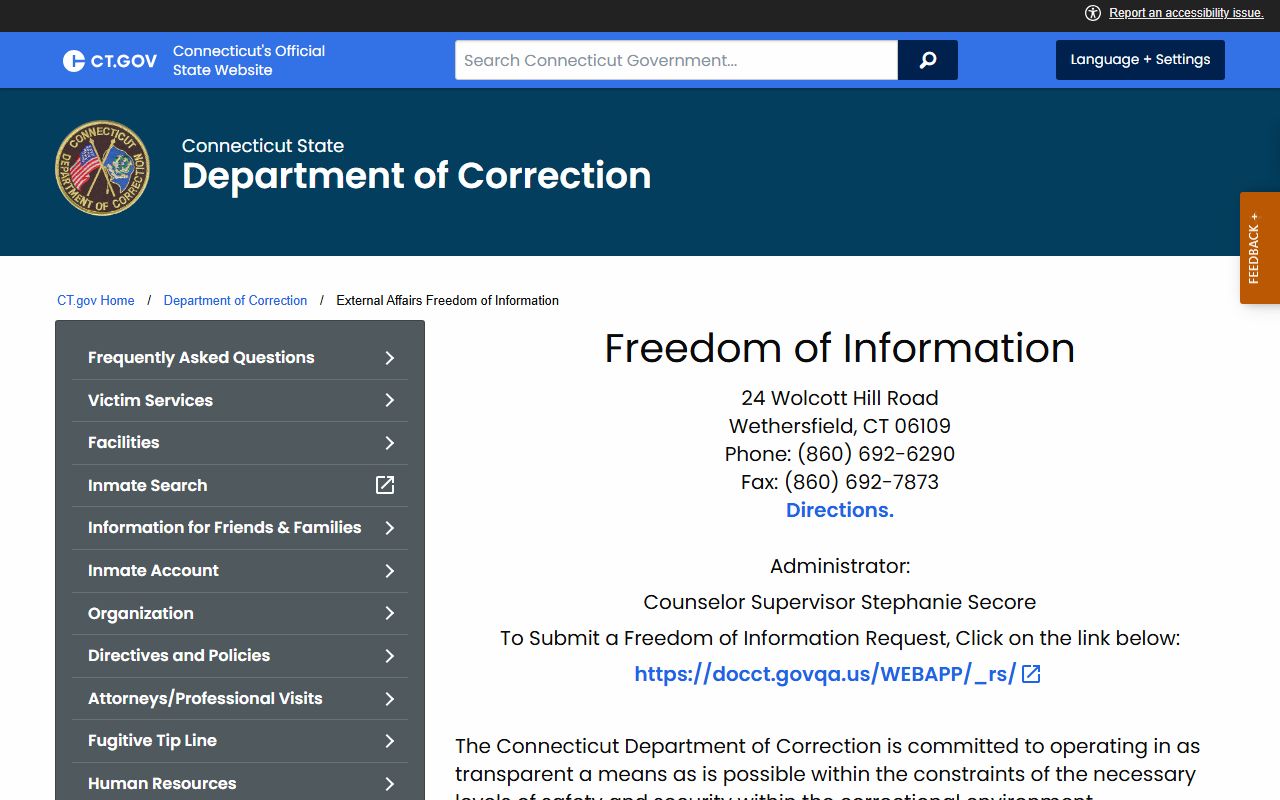
That page links to the GovQA request portal and lists the FOI office phone and fax, which makes it the correct starting point for a state-held booking record. Follow the steps below for a clean request.
- Search the Connecticut DOC inmate search for custody status. If a photo appears, rely only on that official source.
- Identify the arresting agency and any open court case. Use the Judicial Branch pending case lookup to confirm the court and docket.
- File a Freedom of Information request with the arresting police department. Cite the arrest-record statute and ask whether a booking photo exists and is disclosable.
- If the record is held by the state, submit a request through the DOC GovQA FOI portal.
- Respect erasure. If a record qualified for erasure, older copies should not be treated as current.
For general offender questions, the DOC Public Information Office answers calls on weekdays. Court charges, by contrast, belong to the Judicial Branch rather than the corrections agency.
Mugshot Removal and Record Erasure
Removal of a booking photo is really a question about erasure. Connecticut erasure law can wipe qualifying police, court, and prosecutor records. It applies after outcomes like a dismissal, a nolle, a not-guilty verdict, a pardon, or the decriminalizing of an offense. This is the legal route, not a paid takedown.
Once a record is erased, it should not be treated as current. A related statute directs entities that buy or bulk-request public criminal records to update and delete erased entries after they receive the erasure information. So the official systems are designed to stop showing erased records, even if older copies linger elsewhere.
The court side of this story matters too. Charges can change, get dismissed, or end without a conviction, and those outcomes drive erasure eligibility. To understand how charges and case outcomes appear after an arrest, see the guidance on court records after a jail arrest. That pathway shows why a public record can lawfully disappear.
Commercial Mugshot Sites Are Not Official
Private mugshot websites are not official custody records. They are not run by the state or by any New Haven County agency. The photos they show can be stale, wrong, or attached to a case that has long since ended. They may not reflect a release, a dismissal, or an erasure that the courts have already ordered.
These sites often sell removal services. Paying them is not the lawful path to clearing a record, and it does not control official systems. The official channels, the arresting agency, the state corrections records process, and Connecticut erasure law, are what actually govern what stays public.
What is and isn't public: Public records can include the statutory record of the arrest and current DOC custody status, while a booking photo may require a records request and is not confirmed in the public state search. Erased, sealed, youthful offender, and immigration-related records can be withheld, and commercial mugshot sites are never the official source.
Federal and ICE Custody Photos
Federal and immigration custody work differently from state custody. The federal Bureau of Prisons runs an inmate locator, and federal immigration authorities run an online detainee locator. Both confirm identity and custody. Neither is a public mugshot gallery in the way commercial sites imply.
The BOP inmate locator covers federal inmates from 1982 to the present and searches by number or name. The ICE detainee locator covers people currently in immigration custody or released within the last 60 days, searched by A-number or by biographical details. People under 18 are not searchable in the immigration system, and recent transfers may not show right away.
One overlap matters for New Haven County searches. The state DOC database leaves out people held on behalf of federal immigration authorities. A New Haven County arrest can lead to state, federal, or immigration custody, and each uses a separate locator. For a fuller view of how these custody systems connect, see the New Haven County jail inmate records guidance, which maps the full search chain.